Polling vs WebSockets vs SSE: Differences, Examples, and When to Use Each
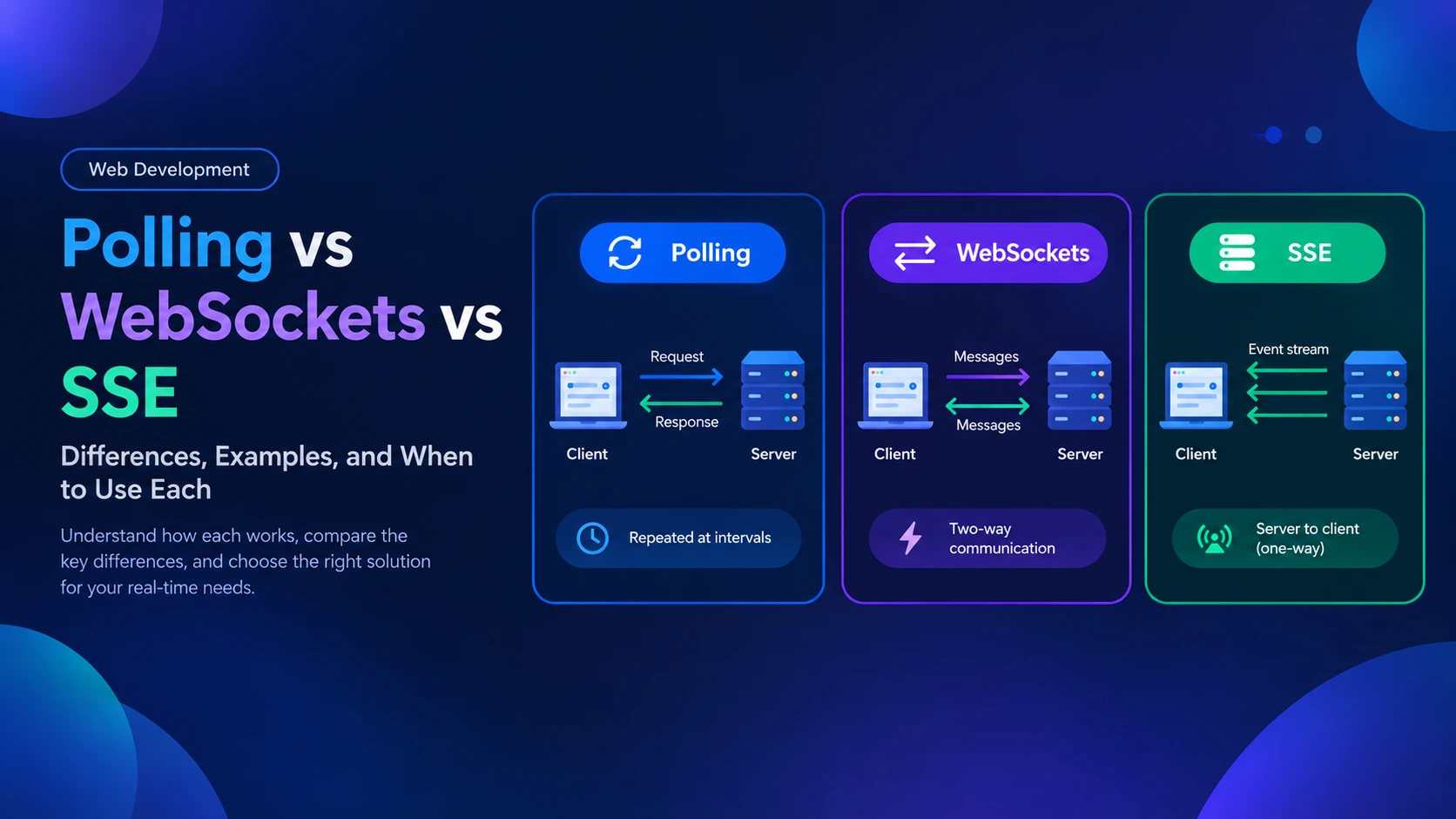
Modern web applications often need to exchange data between clients and servers without requiring users to refresh the page. Live notifications, chat applications, stock market updates, dashboards, and real-time order tracking are common examples.
Several technologies make this possible, but three popular approaches are Polling, WebSockets, and Server-Sent Events (SSE). Although all three can deliver updates to users, they differ in communication patterns, connection management, responsiveness, and infrastructure requirements.
In this guide, we will explore Polling first, followed by WebSockets and SSE. We will compare their advantages and limitations, examine practical use cases, and explain how to choose the right approach for your application.
1. What Is Polling?
Polling is a communication technique in which a client repeatedly sends requests to a server at regular intervals to check whether new information is available. Instead of automatically pushing updates whenever data changes, the client periodically asks the server for the latest information.
For example, an order-tracking application might request the current order status every five seconds. If the order status changes, the client displays the update when it receives a response containing the new status.
How Does Polling Work?
Polling follows a repeated request-and-response process. The client sends an HTTP request, the server returns the current data, and the client waits for a configured interval before making another request. This continues until polling is stopped.
If information changes between two requests, the client generally discovers the change during the next request. Consequently, the polling interval influences how quickly updates become visible.
Types of Polling
Short Polling
Short polling sends requests at relatively frequent intervals, such as every few seconds. It is simple to implement but can generate many unnecessary requests when the underlying data rarely changes.
Long Polling
Long polling allows the server to hold a request open until new information becomes available or a timeout occurs. After the server responds, the client sends another request. This can reduce empty responses compared with short polling, although repeated requests and connection management are still required.
Advantages of Polling
- Simple implementation: Uses familiar HTTP request-and-response mechanisms.
- Broad compatibility: Works with standard browsers, HTTP clients, and conventional backend infrastructure.
- Easy debugging: Requests and responses can be inspected using browser developer tools.
- Suitable for occasional updates: Works well when information does not need to be delivered immediately.
- Straightforward recovery: Clients can request the latest state again after a temporary network interruption.
Disadvantages of Polling
- Unnecessary requests: Repeated requests may return unchanged data.
- Delayed updates: The polling interval affects how quickly changes are detected.
- Increased server workload: Frequent polling from many clients can generate substantial request volume.
- Additional bandwidth usage: Repeated requests and responses consume network resources.
- Less efficient for continuous updates: Applications requiring frequent, low-latency communication may benefit from persistent connections.
Real-World Use Cases for Polling
Polling is a good choice when a small delay is acceptable and implementation simplicity is important.
- Checking whether a background job has completed.
- Updating order or payment status periodically.
- Refreshing dashboard statistics every few minutes.
- Checking the progress of report generation.
- Refreshing data that changes infrequently.
Best suited for: Applications that need occasional updates and prioritize simplicity over immediate delivery.
2. What Are WebSockets?
WebSockets enable persistent, bidirectional communication between a client and a server over a single connection. Once the connection is established, either side can send messages whenever necessary without requiring a new HTTP request for every message.
For example, in a live chat application, a user can send a message to the server, and the server can deliver incoming messages without waiting for another polling request. This makes WebSockets suitable for interactive applications that need frequent communication in both directions.
How Do WebSockets Work?
WebSocket communication begins when the client initiates an HTTP-based upgrade handshake. If the server accepts the upgrade, a WebSocket connection is established. The connection remains open while both sides maintain it, allowing the client and server to exchange messages independently.
The connection closes when either side or the underlying network terminates it. Applications must account for disconnections and decide how connections should be re-established.
Key Features of WebSockets
- Bidirectional communication: Both the client and server can initiate messages at any time.
- Persistent connections: A single connection supports many messages.
- Low-latency messaging: Messages can be delivered as soon as data becomes available.
- Event-driven communication: Applications can react to incoming messages immediately.
- Flexible message formats: Applications can exchange text or binary data.
Advantages of WebSockets
- Real-time updates: Messages can be delivered with minimal application-level delay.
- Two-way communication: Both sides can initiate communication.
- Efficient repeated messaging: A persistent connection avoids repeated request setup for every message.
- Interactive experiences: Suitable for applications involving frequent user actions and server updates.
- Flexible data exchange: Supports text and binary messages.
Disadvantages of WebSockets
- More complex infrastructure: Connection management, reconnection, authentication, and message handling require careful design.
- Connection management: Servers must maintain and manage many simultaneously connected clients.
- Scaling requirements: Multi-instance deployments may need a shared message broker or another method to distribute messages between servers.
- Operational considerations: Load balancers, reverse proxies, connection timeouts, and deployments must support long-lived connections.
- Security requirements: Applications must authenticate connections, authorize actions, validate incoming messages, and apply appropriate rate limits.
Real-World Use Cases for WebSockets
- Live chat and messaging applications.
- Multiplayer online games.
- Collaborative document editing.
- Real-time trading interfaces.
- Interactive sports applications.
- Dashboards that support immediate user actions and server updates.
- Collaboration tools with live presence indicators.
Best suited for: Applications requiring continuous, low-latency, bidirectional communication.
3. What Is Server-Sent Events (SSE)?
Server-Sent Events, commonly known as SSE, is a browser technology that allows a server to send a continuous stream of updates to a client over an HTTP connection. Unlike WebSockets, SSE is designed primarily for one-way communication from the server to the client.
The client establishes a connection, and the server sends events whenever new information becomes available. The connection can remain open, allowing updates to arrive without repeated polling requests.
For example, a monitoring dashboard can receive server-health updates as they happen without repeatedly requesting the latest status.
How Does SSE Work?
The client opens an HTTP connection to an SSE endpoint. The server responds using the appropriate event-stream content type and keeps the connection open. Whenever new information is available, the server sends an event that the browser can process.
If the connection is interrupted, the browser's EventSource API can automatically attempt to reconnect. SSE also supports event identifiers, which can help a client resume event delivery when the server supports replaying events.
Key Features of SSE
- One-way communication: The server sends updates to the client.
- Persistent HTTP connection: The connection stays open to deliver events as they become available.
- Automatic reconnection: The browser can retry a connection after certain interruptions.
- Event-based messaging: Events can include identifiers, event names, and data.
- HTTP-based infrastructure: SSE can integrate with existing web infrastructure when streaming is configured correctly.
Advantages of SSE
- Simple server-to-client streaming: Ideal when clients mainly consume updates.
- Automatic reconnection: Reduces the amount of custom client-side connection management required.
- Event identifiers: Can support resuming event delivery when the server implements replay behavior.
- HTTP compatibility: Uses familiar HTTP infrastructure and conventions.
- Efficient continuous updates: Avoids repeated polling requests while the connection remains healthy.
Disadvantages of SSE
- One-way communication: SSE itself does not provide a bidirectional messaging channel.
- Text-based events: Standard SSE messages are text-based, so binary data generally requires another format or transport.
- Connection limits: Browser and infrastructure limits can affect the number of simultaneous connections, especially when HTTP/1.1 is used.
- Streaming configuration: Proxies and servers must avoid buffering event responses in ways that delay delivery.
- Authentication considerations: Browser EventSource has constraints around custom request headers, so authentication needs to be designed accordingly.
Real-World Use Cases for SSE
- Live notifications and activity feeds.
- Live dashboards and monitoring updates.
- News feeds and content updates.
- Order-status notifications.
- Background job progress updates.
- Live scores and public data streams.
- AI-generated text streaming from a server to a user interface.
Best suited for: Applications that need continuous server-to-client updates without requiring bidirectional communication.
4. Polling vs WebSockets vs SSE: Key Differences
Although these technologies can all be used to update a user interface, their communication models are different. Polling repeatedly requests data, WebSockets provide bidirectional messaging, and SSE streams events from the server to the client.
| Feature | Polling | WebSockets | SSE |
|---|---|---|---|
| Communication | Repeated client requests | Bidirectional | Server to client |
| Connection model | Separate requests or held long-polling requests | Persistent connection | Persistent HTTP stream |
| Update delivery | At the next poll or response | As messages are sent | As events are sent |
| Client-to-server messages | Yes, through requests | Yes, through the connection | Requires a separate request or channel |
| Server-to-client updates | Returned in responses | Yes | Yes |
| Automatic reconnection | Application-dependent | Usually implemented by the application or library | Supported by EventSource |
| Data format | Depends on the HTTP response | Text or binary messages | Text-based event stream |
| Implementation complexity | Low for short polling | Moderate to high | Low to moderate |
| Typical use case | Periodic status checks | Chat and interactive applications | Notifications and live feeds |
5. When Should You Use Polling, WebSockets, or SSE?
The right technology depends on how frequently your data changes, how quickly updates must reach the user, whether communication needs to be bidirectional, and how much operational complexity your team can manage.
Choose Polling When
- Updates are needed only occasionally.
- A small delay is acceptable.
- The application needs a simple implementation with conventional HTTP requests.
- You are checking the status of a background task or periodically refreshing a dashboard.
For example, a report-generation page that checks whether a report is ready every ten seconds may not need a persistent connection.
Choose WebSockets When
- Both the client and server must send messages frequently.
- Low-latency, interactive communication is important.
- The application needs continuous messaging or shared real-time state.
- Users need to exchange information with one another through the server.
For example, a multiplayer game or live chat application benefits from a communication channel that supports messages in both directions.
Choose SSE When
- The server primarily sends updates to the client.
- Updates should arrive continuously without repeated polling.
- You want browser-supported event streaming and reconnection behavior.
- The application displays notifications, activity feeds, monitoring metrics, or generated text.
For example, a live administrative dashboard can receive server events while using ordinary HTTP requests for actions such as filtering data or updating settings.
6. Performance and Scalability Considerations
Choosing a communication method involves more than comparing theoretical speed. Real-world performance depends on message frequency, the number of connected clients, network conditions, server architecture, and the size of each update.
Request Overhead
Short polling can create substantial request overhead when many clients check for changes frequently. WebSockets and SSE can avoid repeated requests for each update by maintaining a connection, although they still require resources to manage those connections.
Latency
Polling latency is influenced by the polling interval. WebSockets and SSE can deliver updates shortly after the server has data to send, making them more suitable for continuously changing information. Actual latency still depends on application processing, network conditions, and server load.
Server Resources
Polling creates repeated request-processing work. Persistent connections require resources for active connections and message delivery. The most efficient option depends on the workload: occasional status checks may be inexpensive with polling, while a large number of continuously updated clients may benefit from streaming.
Scaling Across Multiple Servers
When a real-time application runs on multiple server instances, the architecture must ensure that updates reach the correct clients. WebSocket systems often use shared messaging infrastructure or a pub/sub mechanism. SSE systems may also need shared event distribution, while polling systems need access to consistent application state.
Reliability and Reconnection
Network interruptions can occur with any approach. Polling naturally retries on subsequent requests, SSE supports automatic reconnection in EventSource, and WebSocket applications commonly implement reconnect logic. If updates must not be lost, design event identifiers, replay mechanisms, or state-refresh operations according to the application's requirements.
7. Security Considerations
Real-time communication introduces security concerns that should be considered from the beginning of development.
- Authentication: Verify user identity before allowing access to protected streams or connections.
- Authorization: Ensure users can receive only the events and data they are permitted to access.
- Transport security: Use HTTPS and secure WebSocket connections in production.
- Input validation: Validate messages and requests before processing them.
- Rate limiting: Prevent abusive connection attempts, excessive messages, and unnecessary polling.
- Connection cleanup: Release resources when clients disconnect or sessions expire.
- Cross-origin controls: Configure allowed origins appropriately and do not treat origin checks as a replacement for authentication.
8. Can You Combine These Technologies?
Yes. An application does not have to use a single communication method for every feature. Combining technologies can provide a practical balance between simplicity and responsiveness.
For example, an e-commerce application might use polling for infrequent inventory checks, SSE for order-status notifications, and WebSockets for a live customer-support chat.
Similarly, a dashboard could use SSE to receive updates from the server while sending user actions through normal HTTP requests. This keeps server-to-client updates efficient without introducing a bidirectional connection when one is unnecessary.
The important consideration is to choose each technology based on the communication needs of the specific feature, rather than adding complexity without a clear benefit.
Conclusion
Polling, WebSockets, and Server-Sent Events solve related but different communication problems in modern web applications.
Polling is a practical option for periodic checks and applications where a small delay is acceptable. WebSockets are ideal for interactive experiences that require low-latency communication in both directions. SSE is a strong choice when the server needs to stream continuous updates to the client over HTTP.
There is no universally best option. Consider the update frequency, communication direction, expected number of clients, reliability requirements, and infrastructure complexity before making a decision.
Understanding these differences helps developers build responsive applications while keeping performance, maintainability, and operational costs under control.